剧本ID:
663861
角色: -1男-1女 字数: 2669
作者:🌿香草女巫🧪
关注



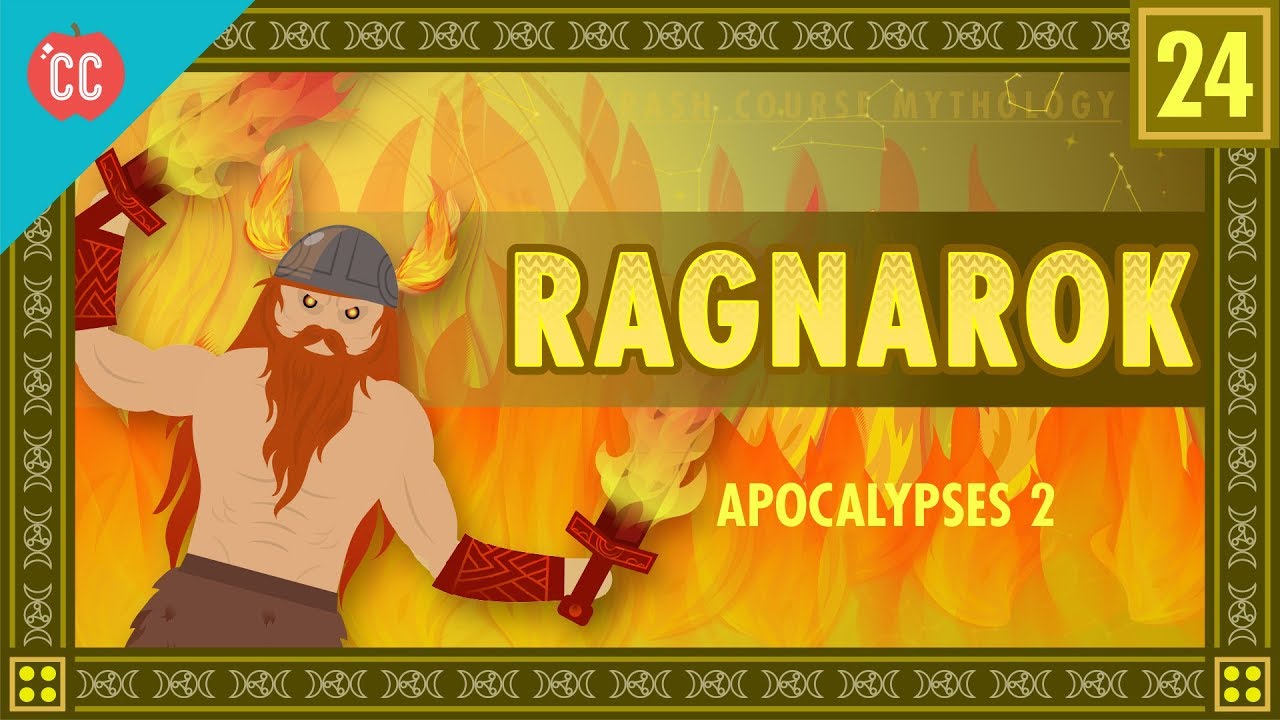
🌳 Ragnarok! It's the end of the world, Norse style. It's got everything you want in an apocalypse. Earthquakes, destruction, armies of the dead, a giant evil wolf, giants with flaming swords, and a kind of happy ending. It's got it all. But is it really Norse? It wasn't written down until after Christianity had arrived in Europe. So how much influence is there?
🌳
1. This is Crash Course Mythology. Last episode we looked at Jewish, Christian, Zoroastrian, and Islamic apocalypse myths, and this episode we're gonna look at one apocalypse myth - one we've all been waiting for. The battle for the ages, the war to end all wars, the inspiration for no fewer than eleven metal bands according to Encyclopedia Metallum.(重金属音乐网站)
That's right, it's the Norse apocalypse: Ragnarok. Battles, earthquakes, fire, blood, a giant wolf, groaning dwarfs, and Loki, who is the worst. That is, until he's not, because he dies. Oh! Spoiler(剧透) alert!
🌳
2. In many versions of the Norse myths, Ragnarok is the conclusion of one Loki story that we've already covered. You might remember a few episodes ago when we talked about the beloved god Baldr, and his brother Hodr, how Loki tricked Hodr into killing Baldr by throwing a dart made of mistletoe? And then, Loki disguises himself as a stubborn frost giant lady, in order to prevent Baldr from escaping the Underworld? Ugh, the nerve.
🌳
3. That's where we left the story last time, and while Loki may have succeeded in getting rid of Baldr, his pleasure is short-lived. When the rest of the Aesir, the rest of the Norse gods of the sky, figure out they've been duped, they fly into various rages, Loki gets scared, and poof, amscrays(俚语,迅速离开) outta Asgard-way.
The rest of the Aesir form a posse(武装队) to bring Loki to justice. Loki decides to hide out in a cave near Frananger Falls. If anyone comes by, he can just transform himself into a salmon, and hide in the churning water(湍急的水流) at the bottom of the waterfall. And sure enough, the Aesir posse shows up, Loki turns into a fish, and dives for safety.
🌳
4. This is when Kvasir(克瓦希尔,北欧神话中的智者), the wisest of all the Aesir, pulls a Sherlock Holmes and notices a burned fishnet in the remains of Loki's fire. "Fish..." He says to himself. "Why would Loki be thinking about fish?" So the gods made a new net, Thor uses it to drag the nearby water, and Loki is caught. The Aesir decide not to kill Loki, but to punish him, and boy, do they ever!
🌳
5. First, they find Vali(瓦利,洛基之子) and transform him into a wolf, then wolf Vali eats Loki's son, Narvi(纳尔维). Then, the gods take Narvi's entrails(内脏,尤指肠子) and use them to tie down Loki inside a cave while Skadi(斯卡蒂), goddess of skiing, hands a snake from a stalactite[stəˈlækˌtaɪt](钟乳石) above Loki's head, positioned so its venom will drop bit by bit, right onto Loki's face, for eternity.
Somehow, Loki's wife Sigyn(西格恩) arranges to stay with her husband, where she sits and uses a wooden bowl to catch the snake venom. But even so, whenever she gets up to empty the bowl, a few drops land right on Loki's face. Rinse and repeat(反复冲洗), except with snake venom for eternity. Or, as Crossley-Holland(英国翻译、作家) put it, "That is how things are and how things will remain...until Ragnarok."
🌳
6. This is actually where the timing gets a little complicated. The story of Ragnarok is obviously very old, but it was originally told as a prediction. This is how the world will end... later. In theory, Loki is still tied up in that cave somewhere, like, right now, trying to get snake venom off his face. So the Ragnarok myth is less of a story of something that already occurred, and more like a script of something that's yet to come.
🌳
7. According to myth, we will know Ragnarok is nigh, because first we will have Fimbulwinter(芬布尔之冬)[1], three long winters all in a row. Cold, bitter, unending winters that make people hungry, and then hangry, and then fight and kill each other. Brothers killing brothers, sisters killing sisters, whole families turning against one another, like when you're on vacation and everyone skips lunch.
🌳
8. Civilization crumbles. Buildings are destroyed through war and neglect, humanity itself deteriorates[dɪˈtɪriəreɪt](恶化,败坏), and people become like wolves to each other. And then when nearly all of the people have killed each other, and those who are alive are acting like beasts, the mythological wolves Sköll(斯库尔,北欧神话中追逐太阳的狼) and Hati(哈提,北欧神话中追逐月亮的狼) will come out and eat the sun and the moon. The stars will fade, and everything will go dark and cold , and there will definitely be no more smorgasbords.[ˈsmɔrɡəsˌbɔrd](瑞典式自助餐)
🌳
9. Boy Norse howdy! Things haven't even gotten going yet! Because now the earthquakes begin. We've talked about apocalyptic earthquakes before - the kind that topple trees and crumble mountains - but these earthquakes will also cause the earth itself to shift. And guess what, to break the bonds keeping Loki, and his giant monster wolf son Fenrir(芬里尔), in captivity. And once Loki is free, the myth tells us, three roosters will crow, waking the giants, the warriors of Valhala, and the dead of single-hockey-stick-Hel, the place.
🌳
10. Meanwhile, Loki's other son, Jörmungandr[ˈjɔrmoŋˌɡɑnd](耶梦加得), the Midgard serpent, will churn through the seas as he heads toward the plains of Vígríðr(维格利德,发音像vee-gi-thee-er,r是大舌音). Newly free and awake, Loki will lead his monstrous sons and all the minions(下属,小卒) of Hel(赫尔,洛基女儿/死亡女神/冥界女王) to march on Asgard and challenge the Aesir. He'll by joined by the giants, led by Surtr(苏尔特尔,火焰巨人), who carries a flaming sword. As this terrible force marches across the Bifröst(彩虹桥) towards Asgard, the great rainbow bridge will collapse behind them.
🌳
11. Heimdall(海姆达尔,彩虹桥守护神), who sees farther than any other god, will spot Loki coming and sound the Gjallarhorn[yahl-lahr-horn](加拉尔号角) in warning. The all-father, Odin, seeing the impending battle, will turn to his trusted advisor, Mimir(密米尔,北欧神话的智慧巨人), for advice. But when giants are marching, and your rainbow bridge is in pieces, and Fenrir and the Midgard serpent are loose, a pep talk(鼓舞士气的话) really isn't gonna help. And so, the Aesir will gear up(挂快挡;加速;准备好) for battle alongside the Einherjar[ane-HAIR-yar](英灵战士), 800 of the most honorable dead warriors from Valhala.
The Aesir and the Einherjar will follow Odin to the plain of Vígríðr to face Loki's onslaught. Let's take a look at the story.
🌳
12. The battle begins and quickly turns into a collection of heroic duels. The fight doesn't go well for anyone. Týr(提尔,战争勇气之神/奥丁之子) and Garmr(加姆,冥界地狱犬) kill each other in battle, Thor defeats Jörmungandr but not before the dying serpent spews venom all over the thunder god and Thor falls, poisoned. Even Loki and Heimdall fight so savagely that they slay each other, which, I guess means that someone else will have to be the worst now? Anyone have any nominations?
🌳
13. As for Odin, he attacks with his mighty spear, Gungnir, but Fenrir seizes Odin in his mighty jaws and swallows the all-father. With Odin consumed, an unlikely hero arises: Odin's son, Víðarr[VIH-dar](维达), and his great magic shoe. Víðarr's mythical shoe is made up of all the thrown-away scraps of all the shoes that have been made since the beginning of time. It is huge, and indestructible. So, Víðarr stomps(踩) his mythic shoe down on Fenrir's bottom jaw, grabs the wolf's top jaw, and rips his head apart! The end of the battle comes when Surtr, leader of the giants, finally defeats Freyr. He turns, and with his flaming sword, sets all the worlds ablaze(着火,燃烧).
🌳
14. According to one version of the story, "Asgard and Midgard and Jotunheim and Niflheim will become furnaces(熔炉) - places of raging flame, swirling smoke, ashes only ashes. The Einherjar will die, men and women and children in Midgard will die, elves and dwarves will die, giants will die, monsters and creatures of the underworld will die, birds and animals will die. The sun will be dark and there will be no stars in the sky. The earth will sink into the sea."
🌳
15. Okay, so look, Ragnarok doesn't end well. The world has been destroyed by flames, and all the people and all the gods are dead, and everything is darkness. Except, in this end of the world story, there is a silver lining. Because the worlds are consumed by flames, what remains is water. And as we've seen in creation stories, water has pretty amazing generative powers. Accordingly, "the earth will rise again out of the water, fair and green. The eagle will fly over cataracts(大瀑布;暴雨;奔流), swoop into the thunder, and catch fish under crags(峭壁,悬崖). Corn will ripen(成熟) in fields that were never sown."
🌳
16. But hold on, it gets even better. It turns out not all of the gods perish in the massive inferno(无法控制的大火;炼狱). Odin's sons, Víðarr and Vali, and Thor's sons, Magni(曼尼,索尔长子/大力神) and Móði(摩迪,索尔次子/勇气之神), survive the fire. They made their way to the plain of Iðavöllr(伊达瓦尔), where they're joined by Baldr and Hodr, who have come back from the world of the dead. Hœnir(海尼尔), and the children of Vili(威利) and Ve(维) round out a new pantheon.
🌳
17. The best part is what happens when these new gods gather together. They sit down and talk, telling the stories that only they know - the same stories of the Norse gods that we're talking about right now. In the grass of Iðavöllr, they find some of the treasures of the Aesir, including Mjolnir(雷神之锤) and some special golden chessboards and their pieces. In a recent retelling of the Ragnarok story by Neil Gaimon(尼尔·盖曼)[1], these pieces are the characters from the myths: Loki and his children, the frost giants, and Surtr. Gaimon ends the story, writing, "Baldr will smile, like the sun coming out, and reach down, and he will move his first piece."
🌳
18. There's a lot to unpack in the Ragnarok myth, starting with whether or not it's really a reflection of the pre-Christian Germanic tradition. You probably notices a lot of similarities between the Christian story of the apocalypse, from the blowing of the horn to the earthquake and the fire. But more importantly, the most beautiful and beloved of the gods, in this case Baldr, returns from the dead. Our main sources for this story, the Eddas(指两部《埃达》)[1], written down well after Christianity became dominant in northern Europe and Iceland. Were the original myths influenced by Christianity?
🌳
19. Well, depends on which scholar you ask. Interestingly, unlike some of the other apocalypses, this one is a beginning, as well as an end. The Christian and Zoroastrian stories also establish a new beginning of a new age, but Ragnarok, even though it's clearly set in the future, prefigures(预示) a renewed world that looks a lot like the old one. In Gaiman's retelling, we almost have the feeling that Ragnarok has happened, even if we're specifically told its events are in the future. The idea that the end of the world can also be the beginning of the world, isn't unique though.
🌳
20. In Hindu mythology, the fourth age, also known as the Kali age(卡利时代), sees humans afflicted by corrupt rulers, and all the social order upended. As in the Norse story, the world will be consumed first by drought, then by fire, followed by a storm lasting many years, and the rebirth of a new world here on earth.
🌳
21. The cyclical nature of the Hindu myth, as well as the twisting of time, is expressed this way: "A day of Brahma(梵天), born from the lotus, lasts a thousands periods of four ages; a night, when the world is destroyed and made into a vast ocean, is of the same length. And at the end of the night, Vishnu, unborn, having awakened, takes the form of Brahma in order to create, as it has already been told to you."
🌳
22. This Indian apocalypse story and Ragnarok are both oddly hopeful. They explain that destruction is necessary for creation. Unlike the apocalypse of the Bible's book of Revelation, they don't promise a new world only for the righteous, but a rebirth for everyone.
Thanks for watching, we'll see you next time. And related, but unrelated - one of those eleven Ragnarok bands is a flute(长笛) metal band.
To be continued…
未完待续…